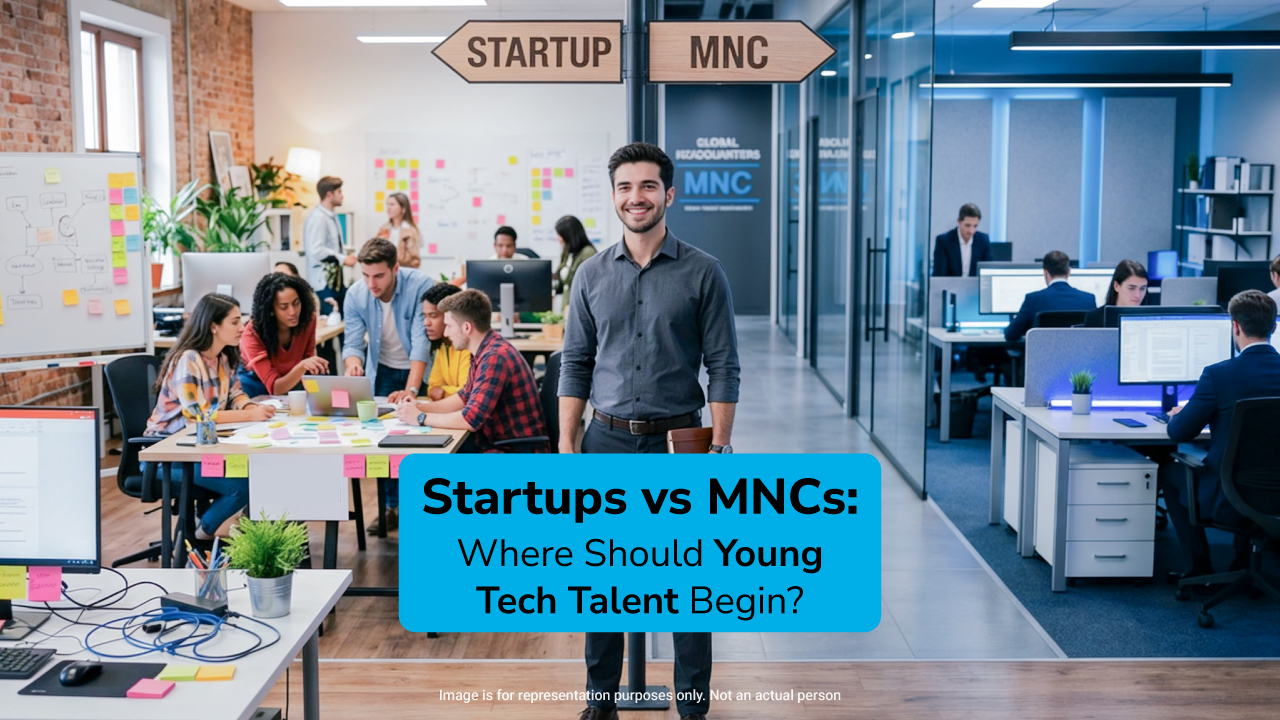
Aarav stepped into his first day at work with a tinge of anxiety and excitement. Earlier, he had received two job offers. One from a fast-growing startup, full of energy and unpredictability. The other was from a well-known multinational company, structured, stable, and globally recognized.
Like many young professionals, he had asked the same question countless times: “Where should I begin?”
The Appeal of Startups: Speed, Ownership, & Learning by Doing
Startups offer something hard to replicate elsewhere: intensity. In a startup, roles are fluid. Responsibilities expand quickly. One day might involve coding a feature, the next could mean speaking to users or solving an unexpected problem.
For someone early in their career, this environment accelerates learning. There is little separation between thinking and execution. You build, test, fail, and adapt in real time.
Aarav noticed this immediately. There were no long onboarding processes or rigid hierarchies. Instead, there was urgency. Every contribution mattered. Every mistake taught something valuable.
But this comes with trade-offs. Startups can lack structure. Guidance may be limited. Expectations are high, and stability is not guaranteed. It demands resilience and a willingness to operate in the face of uncertainty.
The Strength of MNCs: Structure, Scale, & Stability
On the other hand, multinational companies offer a very different experience. Processes are defined. Roles are clear. Systems are in place to support learning and growth.
In an MNC, Aarav would have had access to established workflows, mentorship frameworks, and exposure to global teams. There is a sense of predictability. You know what is expected, and you have the resources to meet those expectations.
This environment is especially valuable for building depth. It allows individuals to specialize, understand large-scale systems, and learn how global organizations operate.
However, the pace can feel slower. Decision-making often involves multiple layers. Opportunities for ownership may take time to emerge.
There Is No One-Size-Fits-All Answer
So the question is not which is best but which is right for you.
Startups are for people who enjoy working in a dynamic environment, experimenting, and dealing with uncertainty. They reward initiative and adaptability.
MNCs are ideal for those who value process, enjoy clear roles and responsibilities, and seek stability and development opportunities within established structures. They offer stability and long-term progression.
Aarav came to learn that it is not about the company but the individual he wanted to be.
What Truly Matters in the Beginning
Regardless of the path chosen, certain factors matter more than the label of the organization:
-
The opportunity to learn actively, not passively
-
Exposure to real-world problem-solving
-
Access to mentorship and feedback
-
The ability to take ownership and see outcomes
-
A culture that encourages growth and experimentation
These elements shape early career experiences far more than the size or reputation of the company.
Laying the Right Foundation
A good foundation reduces the risk. When people learn to think for themselves, learn quickly, and apply their knowledge in practice, they can thrive in startups and larger companies.
The early years of a career are not about finding the perfect environment. They are about building the capability to grow in any environment. You learn to adapt, embrace challenges, and develop resilience. Each experience, even if imperfect, adds to your skill set. Ultimately, the ability to thrive anywhere becomes your greatest asset.
How TheBridge Prepares Talent for Both Paths
TheBridge focuses on preparing individuals for this exact decision point. Instead of training for a specific type of company, it builds a foundation that works across both startups and multinational environments.
Project-based work allows learners to experience challenges similar to those of startups while benefiting from the structure and control of larger companies. They learn to take initiative, make decisions, and solve problems under different circumstances.
Mentoring helps them understand their career options and adapt to different work cultures. Industry exposure enables them to fit in easily, whether they work in a startup or a multinational company.
At the same time, communication, teamwork, and flexibility are emphasized, which are required in all environments.
The aim is not to choose between startups and MNCs, but to be prepared for both.
After all, it's not the starting point, but how much you learn, adapt, and evolve that counts the most.