Article
What Makes a Career Accelerator Program Actually Work!
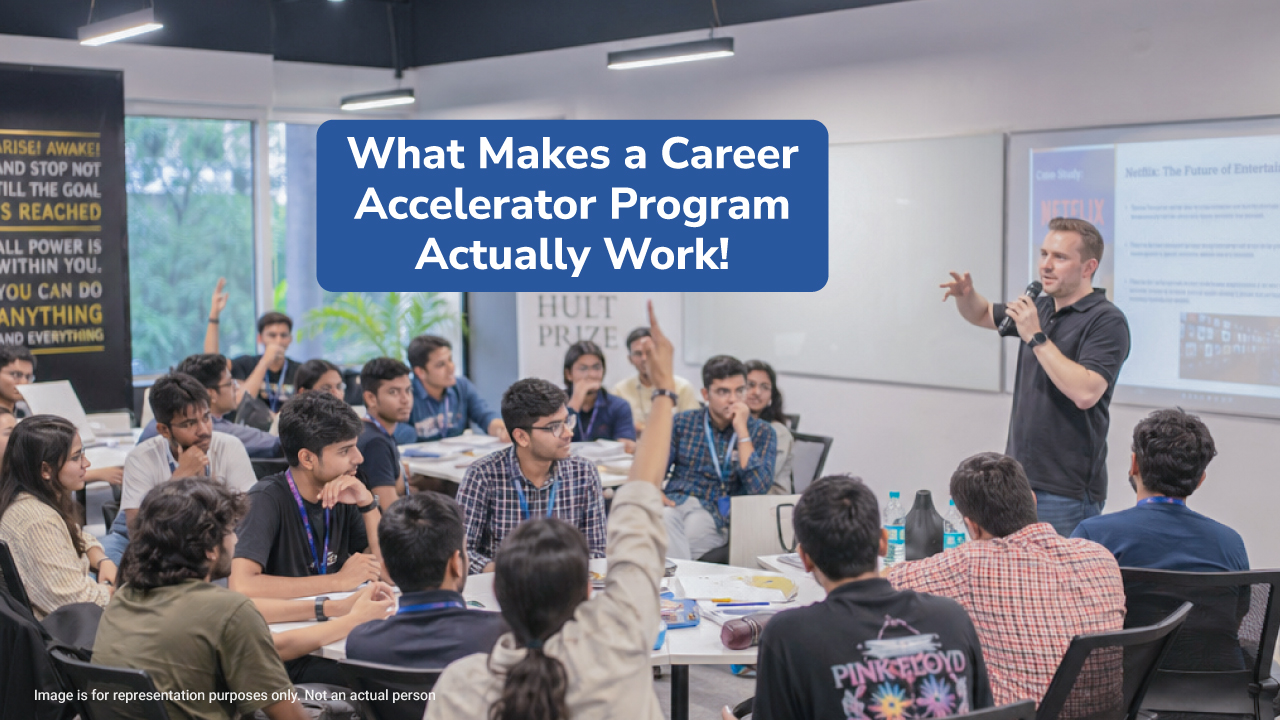
A crowded webinar ends with a familiar promise: faster placements, better salaries, real-world skills. The slides are polished, the testimonials are compelling, and the roadmap looks clear. Yet months later, many learners find themselves in the same place, with more information but not necessarily more direction.
This raises an important question. What actually makes a career accelerator program effective?
The answer lies not in how much content is delivered, but in how transformation is created.
Beyond Content: From Information to Capability
Many programs are focused on content. They offer courses, modules, and certificates designed to develop knowledge. This is important, but it doesn't often translate into employability.
The workplace requires application. They demand that people take fuzzy problems and organize them to achieve results. A good accelerator program is not about knowledge, it's about potential.
This means they're not just learning, but they're doing. They create, experiment, fail, and learn. As a result, they build both skill and confidence.
The difference is simple. Content informs. Experience transforms.
Learning That Mirrors the Real World
The most effective programs replicate the conditions of real work. Instead of predefined exercises with clear answers, learners are exposed to open-ended challenges.
In these settings, there are no right or wrong answers. Incomplete information is available. Trade-offs must be evaluated. Collaboration becomes essential.
Here is where the learning occurs.
Learning in these environments helps students to work like pros. They prioritize, communicate, and take responsibility. They learn that success is more important than effort.
A program that simulates reality prepares individuals for reality.
The Role of Mentorship & Feedback
Mentorship is another distinctive aspect of an accelerator. In the absence of guidance, it's easy for a learner to lose sight of the bigger picture. They may work hard, but not always work on what matters most.
Mentorship bridges this gap.
Experienced professionals bring perspective. They help learners understand industry expectations, refine their approach, and avoid common mistakes. More importantly, they provide specific, timely, and actionable feedback.
Feedback is what converts activity into improvement. It ensures that learning is not just continuous, but also meaningful.
Building Confidence Through Execution
Career readiness is not only about skills. It is about confidence.
Confidence is built when individuals see the results of their own effort. When they solve a problem, deliver a project, or overcome a challenge, they begin to trust their ability.
This trust is critical.
In interviews, confidence shapes how ideas are communicated. In teams, it influences participation and collaboration. In careers, it determines how individuals handle uncertainty and growth.
An effective accelerator program does not just teach skills. It creates environments where confidence can be built through execution.
Alignment With Industry Expectations
A common gap in traditional learning is misalignment with industry needs. What is taught does not always reflect what is required.
Strong accelerator programs address this directly. They design learning experiences that are aligned with real roles, tools, and workflows. Learners are exposed to the expectations they will face, not just the concepts they need to understand.
This alignment ensures that when individuals step into professional environments, they are not starting from zero. They are continuing from where they left off.
From Completion to Transformation
Many programs measure success by completion rates. How many learners finished the course? How many modules were covered?
But completion is not transformation.
Transformation is seen in people's thoughts, behaviors, and performance. It can be seen in their problem-solving, communication, and coping skills.
This is the focus of an effective accelerator program. It's focused on progress, not completion; skill, not content; and practice, not teaching.
How The Bridge Enables Real Career Transformation
The Bridge embodies these principles. We understand that career acceleration is not about accelerating learning, but about engaging in more relevant, experiential learning.
Structured project learning provides opportunities for people to work on problems, think, make,, and do. It's not about the solutions, but rather the capacity to solve problems.
Coaching is integral to the learning experience, providing ongoing support and feedback. This enables them to meet industry demands and gain clarity on their career paths.
At the same time, human skills like communication, co-operation, and adaptability are emphasized. These are complemented by technical abilities to produce a well-rounded, forward-looking profile.
Because what makes a career accelerator truly work is not how fast it delivers content, but how effectively it prepares individuals to perform beyond it.