Article
Human + AI: The New Skill Stack Every Student Needs
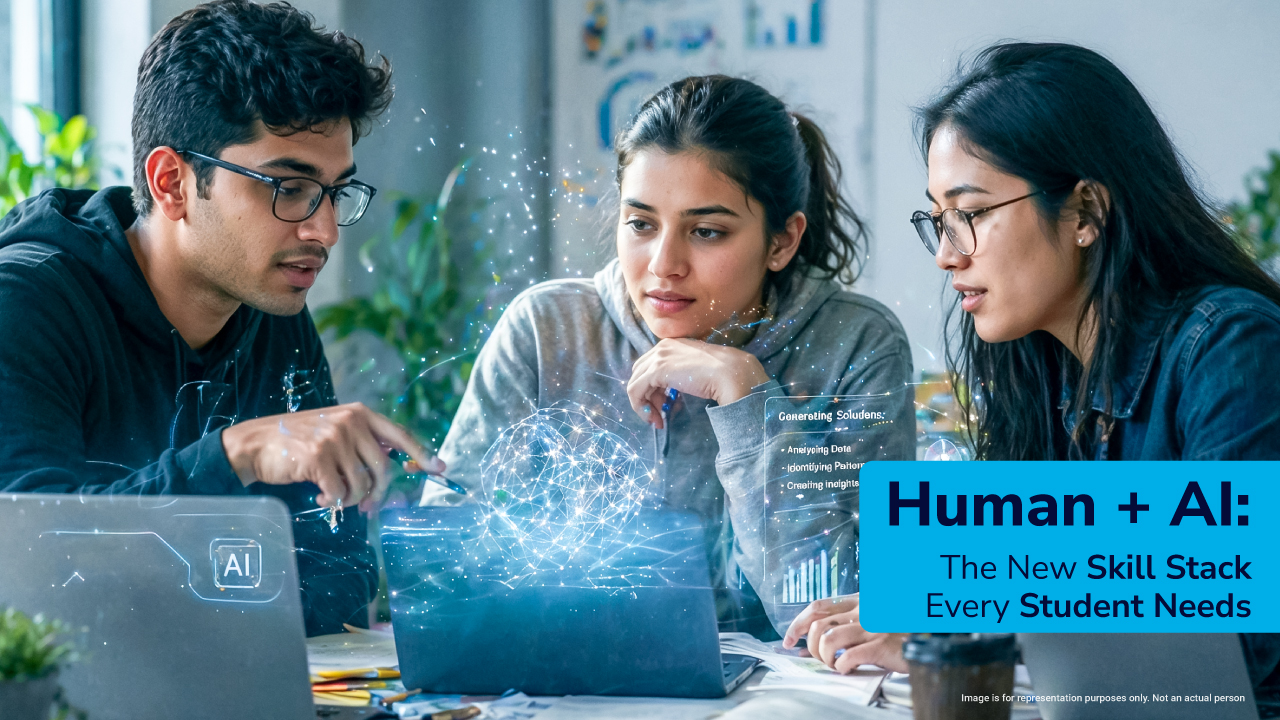
The screen glowed late into the night. Lines of code, half-finished ideas, and multiple tabs competed for attention. There was no lack of effort. Tutorials had been watched, notes had been made, and concepts had been memorized. Yet, a quiet question lingered beneath all of it: Is this enough?
For a long time, learning meant acquiring knowledge. Today, learning means knowing how to use that knowledge with intelligent systems. The shift is subtle, but it is redefining what it means to be skilled.
When Knowledge Is No Longer Enough
In earlier models of education, success was built on accumulation. The more you knew, the more valuable you were. But in a world where AI can retrieve, summarize, and generate information instantly, the value of simply knowing has changed.
What matters now is how you think, not just what you know.
Students today are not competing only with each other. They are working alongside systems that can process data at a scale no human can match. This does not reduce human importance. It elevates the need for distinctly human capabilities.
The real question is no longer, “Can you do the task?” It is, “Can you guide the system, question the output, and improve the result?”
The Rise of a New Skill Stack
The future belongs to those who can combine human intelligence with artificial intelligence. This creates a new kind of skill stack.
On one side are technical and digital skills. The ability to understand tools, write prompts, analyze outputs, and work with AI systems effectively.
On the other side are human capabilities. Critical thinking, communication, creativity, ethical judgment, and adaptability. These are not optional. They are what make AI useful in the first place.
When these two sides come together, something powerful happens. Work becomes faster, but also more thoughtful. Decisions become data-informed, but still human-led. Creativity expands, rather than being replaced.
A student who understands how to ask better questions of AI will always outperform someone who uses it for quick answers.
From Passive Learning to Active Collaboration
Future-readiness is not about knowing a tool or language. It is about developing a mindset.
It means embracing change. It means knowing how to learn, and learning how to learn. It means realizing that skills are likely to change and that adaptability will be more important than knowledge.
In the future, the most important people will not be those who know everything. They can deal with uncertainty, ask the right questions, and leverage both humans and machines.
This is where the gap becomes visible. Many students still follow traditional methods, focusing on completion rather than creation. They prepare for exams, but not for execution.
The ones who move ahead are those who treat AI not as a shortcut, but as a collaborator.
Redefining What It Means to Be Future-Ready
Being future-ready is not about mastering a single tool or language. It is about developing a mindset.
It means being comfortable with change. It means learning how to learn, again and again. It means understanding that skills will evolve and that adaptability will matter more than static knowledge.
In this new world, the most valuable individuals are not those who have all the answers. They are the ones who can navigate uncertainty, ask better questions, and combine human insight with machine capability.
The future of work will not be human versus AI. It will be human with AI.
How The Bridge Builds This New Skill Stack
The Bridge is built on this change. It understands that to prepare students for the future, it's not enough to teach them technical skills; it's about building a full skill stack.
Students engage in project-based learning, solving real-world problems, and AI can be used as a thinking tool. Students learn to define problems, work with smart systems, and iterate and refine solutions.
But at the same time, human skills are emphasized. Collaboration, communication, decision-making, and ethics are all key parts of the learning experience. Students are not only taught how to use technology, but how to drive it.
Practical exposure and mentoring ensure that learning is not theoretical. They learn how to apply their talents to global roles and become more confident.
The goal is simple. To turn students from consumers to producers. From consumers to partners.
Because the future will not reward knowledge, it will reward those who can think, learn, and build with human and artificial intelligence.