Article
Beyond Coding: The Human Skills that will Define Technology Careers in the AI Era
When Rishi was leaving school in Pune, he had a dream, as many young Indians do. He wanted to attend one of the best universities in the United States to study technology. That, in his mind, was the key to innovation, global exposure, and the possibility of developing solutions that would reach the world.
But the facts soon put in their claim. International education was too expensive for his family to afford. Scholarships were a competition, and a foreign education loan was like a lifetime commitment. The dream of global technology learning was far away at one point.
But Rishi never quit his learning.
And, like thousands of other students across India, he began educating himself in programming online. His evenings were spent on Python tutorials, Python challenges, and small projects. Gradually, he started creating applications and testing artificial intelligence devices. On the surface, he appeared to be doing everything right. He was learning to code.
However, there was something of interest during one of his online student hacks.
Leadership & Collaboration: Key Differentiators in Tech Teams
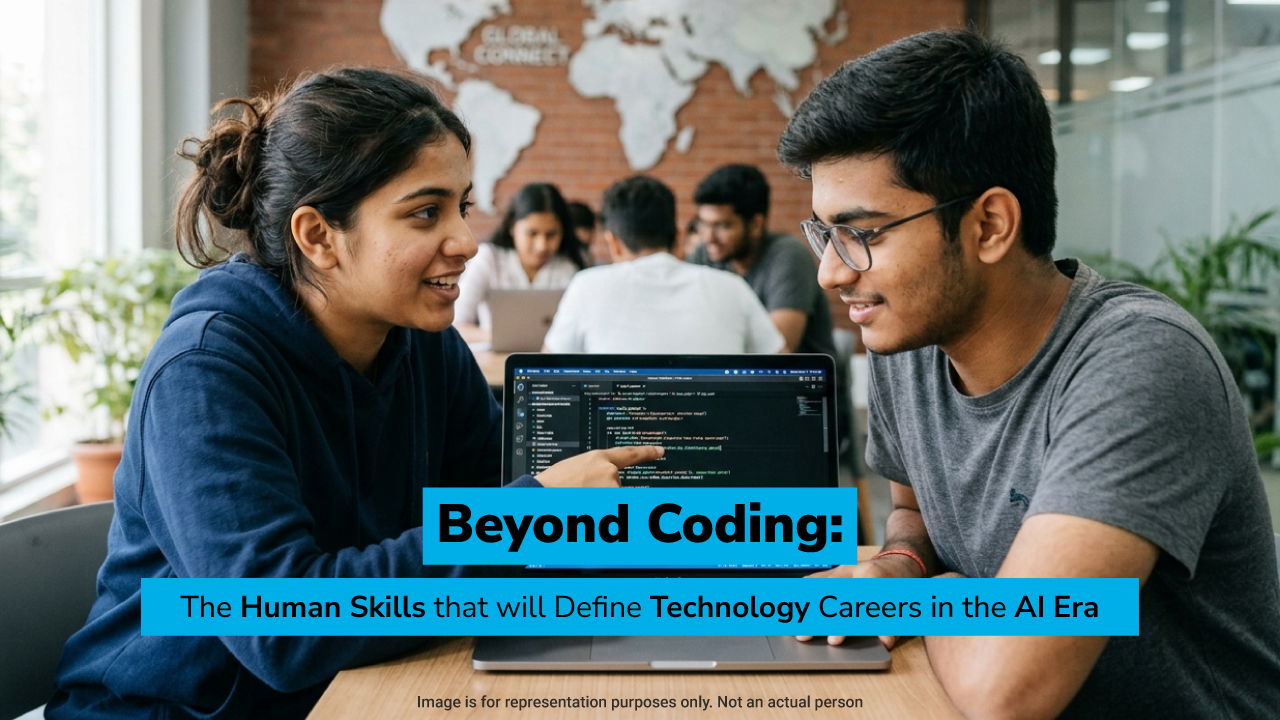
His team comprised students in various regions of the world. There were also other stronger programmers than Rishi. There were those with lesser technical experience. However, the student left to lead the team was not the quickest coder. It was she who could put the problem into perspective, organize the group, and turn ideas into something worthy.
It was that time that Rishi had a shift in perception towards technology careers.
Over the years, students have held the view that learning programming languages is the most significant step towards success in the technology industry. However, coding remains a strong skill, and the emergence of artificial intelligence is transforming the nature of work in significant ways. AI systems are now useful for many routine coding tasks, including code generation, review, and optimization, which can take seconds.
This does not diminish the relevance of technology professionals. Rather, it underscores the importance of another group of human skills that machines cannot easily imitate.
Problem Framing: The Foundation of Tech Innovation
Problem framing is one of the most significant such skills. Technology is not simply about software development, but also about defining significant problems and developing solutions that improve people's lives. One thing that will not be eliminated by the AI age is the need for professionals who can read user needs, extract complexity, and identify the correct problem to solve.
Another essential skill is creativity. Artificial intelligence can analyze and automate activities, but it still relies on human imagination to be innovative. Creative thinkers relate technology to real-world impact, whether by creating new digital products, developing sustainable technologies, or enhancing healthcare systems.
Modern technology roles have also been focused on communication. Technology teams almost never work alone. Engineers work alongside designers, product managers, business leaders, and policymakers. The point of contact between innovation and implementation, when able to clarify technical concepts and convert complex ideas into real-world actions, is usually a professional who can do both.
Another essential attribute is teamwork. The greatest technological innovations nowadays are the result of teamwork, not of individuals. Teams can now work on opposite sides of a continent thanks to cloud platforms, international research networks, and remote collaboration tools. Listening skills, exchanging ideas, adapting to other points of view, and collaborating with others have become as important as technical knowledge.
Ethical Judgment: Navigating Technology's Social Impact
Another dimension receiving growing attention is ethical judgment. Artificial intelligence systems are used to make decisions in healthcare, finance, education, and public service provision. Professionals working in technology should consider fairness, transparency, and social impact when developing these systems. Critical evaluation of the ethical implications of technology is becoming an inseparable aspect of professional responsibility.
Rishi also began building these skills slowly, without his knowledge. He began engaging in open-source projects where developers discussed their work with one another. He got involved in online communities where ideas were discussed and refined. He stopped thinking about coding alone and started thinking about how technology could address real people's problems.
One of the projects he worked on was creating a simple AI-based tool to help small-shop owners monitor inventory. It was not that the technical solution was very complicated; the actual problem was to understand how the shop owners could work in practice, what information they required, and how technology could become part of their everyday lives.
Experiences such as this have helped Rishi learn that there is something good about technology professionals who are not mere software builders; they are solution constructors!
The Future of Technology Careers: Integrating Technical Skills with Human Insight
Technology careers will be determined by those who can merge both technical and human understanding in the future. They will be people-oriented engineers, systems-oriented designers, and technology-solvers and innovators.
This change also implies that international opportunities are becoming more accessible. Students do not have to physically move to engage with international learning facilities or to work on global technological projects. Online platforms, distance learning, and the emergence of new learning environments are opening many opportunities previously accessible only to a few.
This realization turned everything around for students like Rishi. The vision of being linked to global technology ecosystems was no longer dictated solely by geography or finances. Of greater importance was the availability of the appropriate learning environment - one with a balance of technical richness and practical exposure, and worldly view.
Bridging the Gap: Practical Tech Education for Indian Students
The Bridge is critical to making this possibility a reality for many students in India. Through its emphasis on globally relevant technology education, The Bridge has enabled learners to move beyond theoretical knowledge into practical, industry-based skills. Students' experience is gained through collaborative projects, exposure to new technologies, and mentoring aligned with industry expectations.
More to the point, The Bridge acknowledges that technology careers are not made of code. Programs focus on problem-solving, teamwork, and communication, as well as the bigger picture in which technology is used. Such a strategy prepares students to engage with technology with great confidence, whether they work remotely with international teams or seek higher opportunities in the future.
For students like Rishi, the path to an international technology career is not necessarily a costly route through a foreign education. However, the opportunities are highly viable with the appropriate hands-on approach, attitude, and mechanisms in place.