The DLX platform · built on Aptitude AI
The course is not the record. The student is.
The Bridge runs on a Digital Learning Experience platform. Instead of storing courses, files and a gradebook, it keeps a live map of what each student can actually do — every claim backed by evidence, updated every time they demonstrate something, and portable when they leave.
A grade is a lossy summary of a person.
The learning management system was designed in the late 1990s to put a catalogue, a roster and a gradebook online. It solved that. It has not meaningfully changed since, and a letter grade still averages dozens of separate skills into one character — which lets strength in one area hide a total gap in another. Employers know this, which is why they screen candidates again themselves.
An LMS organises around
A DLX organises around
The course
The learner
Content delivery
Demonstrated capability
Time enrolled
Competency achieved
Completion
Employment outcome
The difference is architectural, not a matter of features. The unit of record is not a course enrolment — it is a competency assertion: a durable, evidence-backed claim that a person can do a specific thing at a specific level. Everything else in the platform exists to generate, verify, improve, credential or act on those claims.
Nine stages, then it becomes a loop.
This is the first pass through. After that a student lives in the cycle — assess, path, learn, practise, demonstrate, credential, apply, new goal — and the record carries across every iteration, including the ones that happen years after graduation.
- 01
Discovery
Start from a role, not a catalogue. See the target, what it requires, and how far away it is, before committing to anything.
- 02
Onboarding
Prior credentials, transcripts and work history are imported. So are your constraints — hours, deadline, how you prefer to learn.
- 03
Baseline
An adaptive diagnostic finds your actual level across the whole skill set in 30–45 minutes. The output is a profile, not a score.
- 04
Your path
Computed from the gap between where you are and where you want to be. What you already know is skipped and credited.
- 05
Learning
Content adapts as you go. Struggling triggers a different explanation; mastery triggers acceleration.
- 06
Practice and labs
Sandboxes, simulations and projects, with feedback during the work rather than a mark afterwards.
- 07
Demonstration
You prove the skill in whatever way suits it — adaptive test, performance task, portfolio. Not passing produces a diagnosis and a new route, not a fail.
- 08
Credentials
Verified skills stack into awards that carry their evidence with them and sit in a wallet you control.
- 09
Work
Your record is matched against live role requirements. You see what you qualify for now, and what is one skill away.
One platform, read two ways.
The same record that tells a student what to do next is the one that tells a faculty member who to help and an employer what a candidate can do. Nothing is exported between them.
For students
-
You start where you actually are
No re-proving what you already know, and no being carried past a gap because the term moved on.
-
The path is computed, not assigned
Two students heading for the same credential can take different routes and both be right. You can see why each step is there, and negotiate it.
-
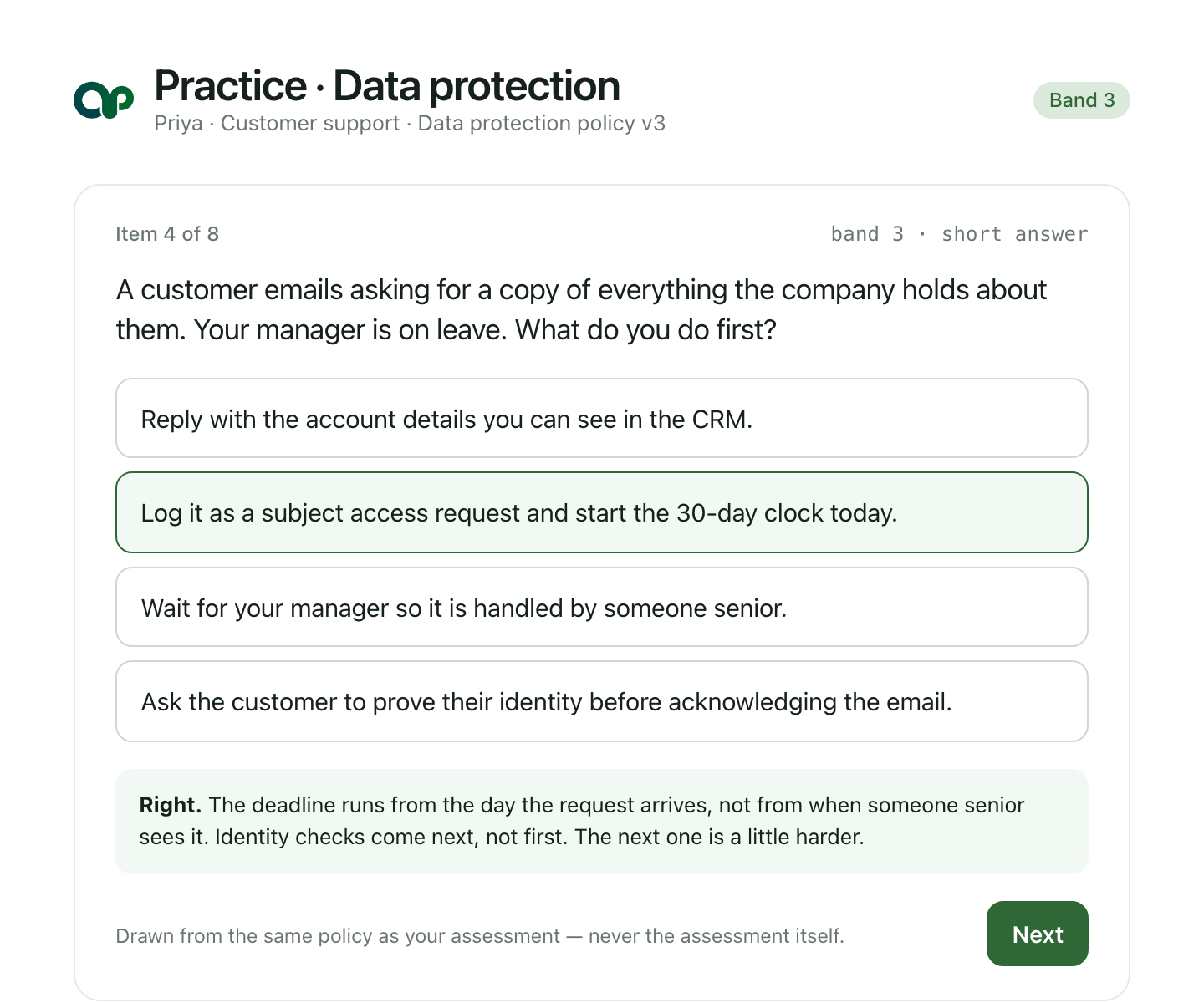
Practice cannot leak the exam
Practice questions are generated from the same material as your assessment and are guaranteed never to be the assessment itself.
-
Proof you can take with you
Every claim about you is backed by a retrievable artefact. Credentials decompose into skills an employer can inspect, and they are yours, not the institution’s.
For institutions and employers
-
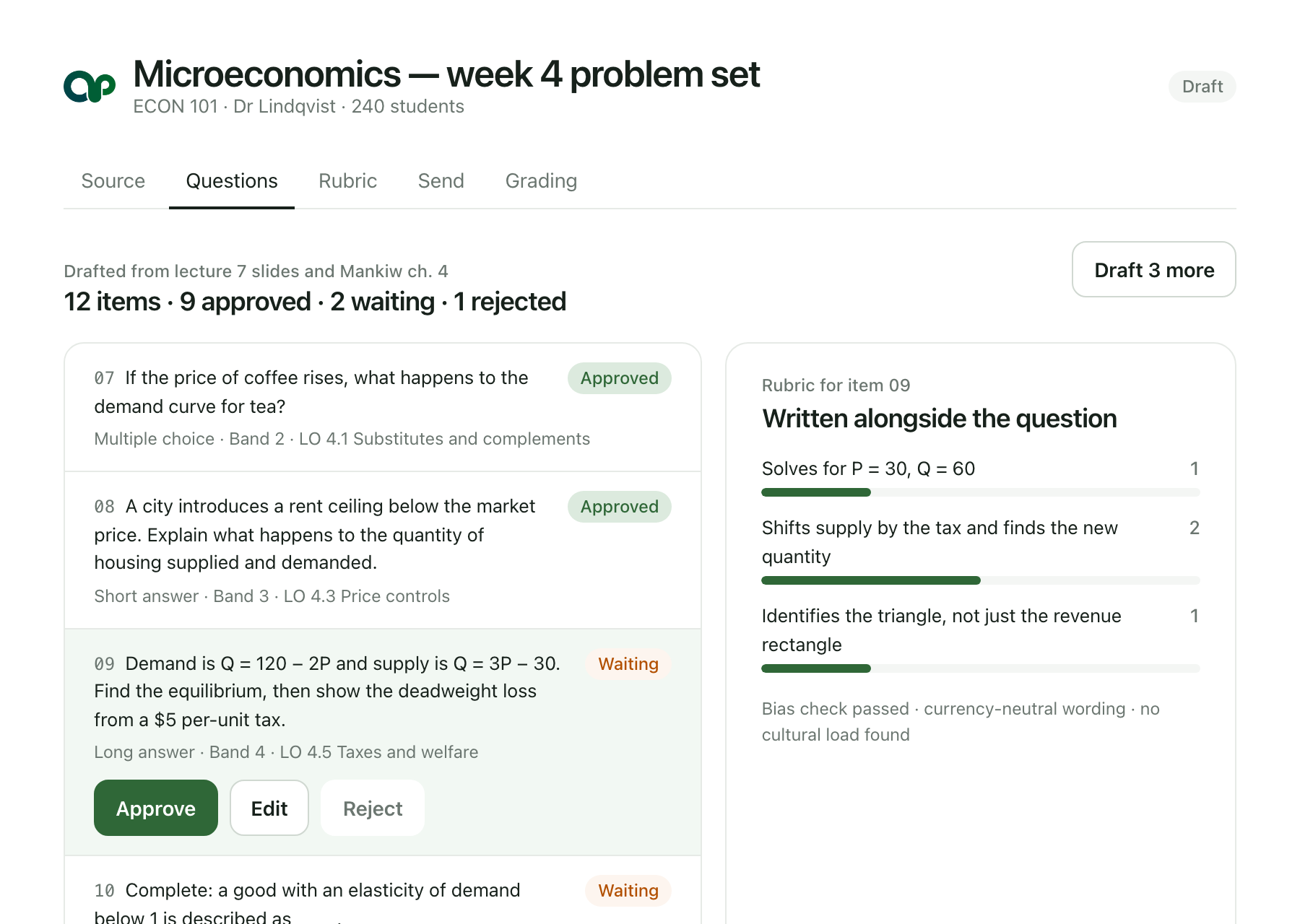
Authoring collapses to minutes
Items and rubrics are drafted from the coursework already in the system, aligned to the standard, and approved or rejected by the teacher. Nothing reaches a student unreviewed.
-
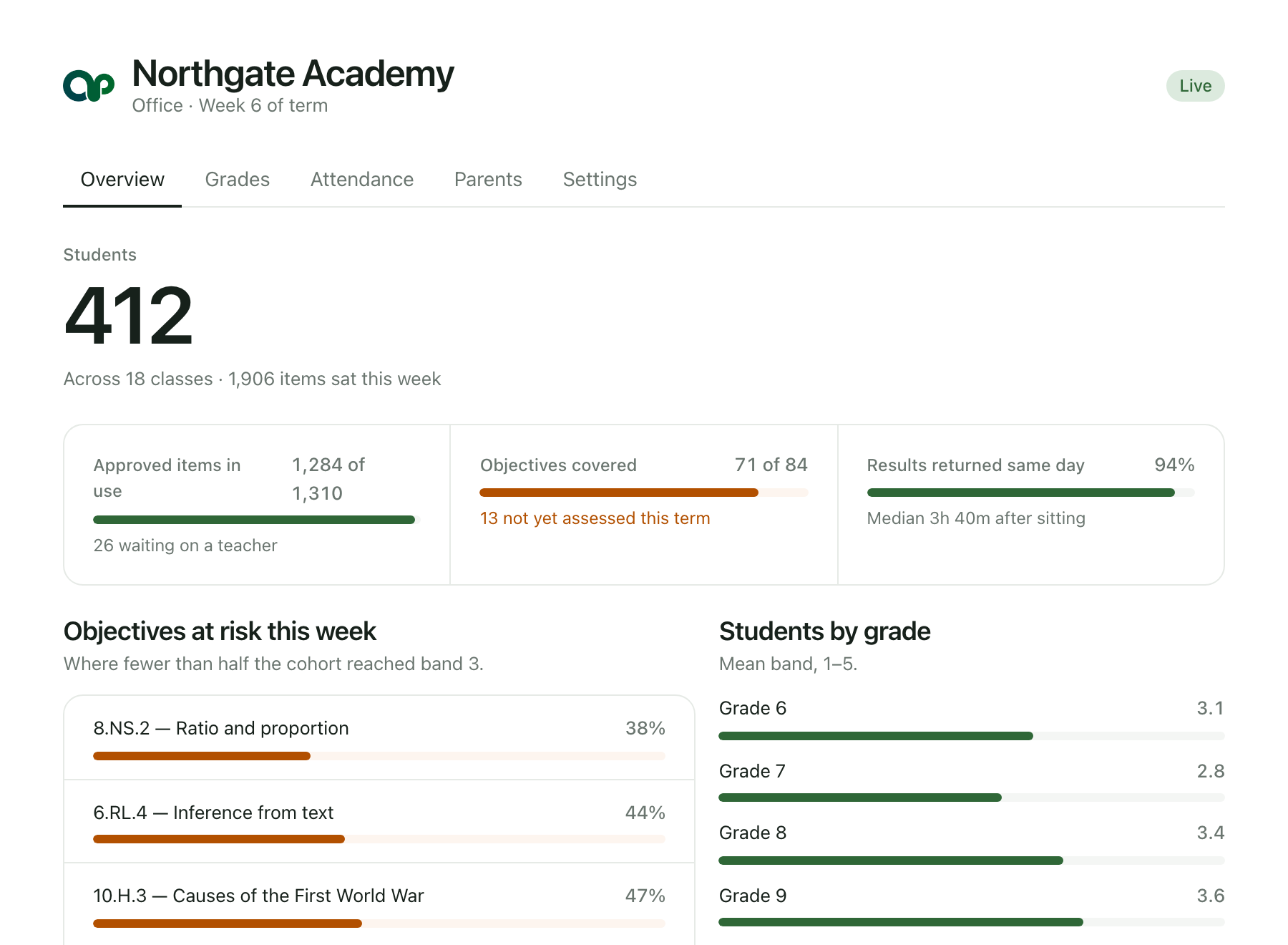
Diagnostics you can act on
Class-level detail precise enough to reteach one misconception rather than a whole unit, and early-warning signals while there is still time to intervene.
-
Evidence for accreditation
Outcomes data that is backed by artefacts rather than by grade averages, packaged for the reviewer.
-
Employers inside the system
Partner employers publish the role requirements that shape the curriculum and can inspect the evidence behind a candidate, instead of reading a transcript.
Analytics that prescribe, not describe.
An LMS dashboard reports logins, page views and submission rates — activity, not learning, and almost nothing is designed to consume it. The DLX runs four tiers deliberately: what happened, why, what will happen next, and what to do about it.
Built outward from assessment, not bolted on to it.
Most platforms start from content and add assessment later, which is why the assessment is usually the weakest part. This one starts from the Aptitude AI portfolio — five products that are really one assessment and evidence engine pointed at five different populations — and builds the rest around it.
-
Adaptive Assessment — K-12
Where a learner’s record begins. Adaptive diagnostic and summative measurement mapped to national and state standards.
-
Adaptive Assessment — Higher Education
The same engine against a post-secondary population, feeding placement, prior-learning credit and programme outcomes.
-
Trainer & Faculty Enablement
The supply side. Standards-aligned item and rubric generation, which keeps the shared item bank stocked.
-
AI Readiness
A six-level organisational maturity diagnostic for enterprises, scored on observed behaviour rather than self-report.
-
LabProof AI
Evaluation of hands-on work from the process trace — what was attempted, what failed, how it was recovered — not just the artefact handed in.
Four of the five consume assessment. One produces it. That closes a loop nobody buying item banks off the shelf can run: faculty generate standards-aligned items, the adaptive engines deploy them, the response data returns real psychometrics, and the generation improves. Every product writes to the same record.
Where this stands
Being built in the open.
The adaptive assessment engine and the faculty authoring tools described here are built and running. The competency graph, the credential wallet and the employer-facing layer are in development, and the full architecture is a published reference design rather than a finished product. We would rather say that plainly than show you a roadmap as though it had already shipped.
If you are a university or an employer weighing a partnership, ask us for the architecture document and we will send it.
See it with your own coursework in it.
Thirty minutes, no pressure — for students deciding, and for institutions weighing the platform.